
Palm Bay, Florida · Residential Cooling
Air Conditioning Repair Palm Bay FL
AC problems can turn a Palm Bay home uncomfortable quickly. Get help identifying problems with no cooling, weak airflow, frozen coils, thermostats, air handlers, heat pumps and other residential cooling issues.
Have an urgent cooling problem? Call to check current availability.
Palm Bay focused
Content and service built around homes in Palm Bay and nearby Brevard County.
Residential AC problems
Cooling, airflow, humidity, drainage, electrical and control issues in houses.
Clear service requests
Describe the symptom, get help sorting out what likely needs attention.
Phone and online contact
Call 321-334-2567 or send a request with details about the system.
AC Trouble in Palm Bay? Start With the Symptom
Cooling problems usually announce themselves in one of a handful of ways. Find the description closest to what your system is doing and follow it to a page that explains the likely causes and what a technician checks.
- The AC runs constantly but the house never gets cool — why an AC runs without cooling
- Air from the vents feels warm or barely cool — AC repair for warm-air problems
- The system will not turn on at all — an AC that won't start
- Airflow at the registers feels weak — duct and airflow problems
- There is ice on the indoor coil or the copper line — frozen coil causes
- Water is pooling near the indoor unit — air-handler and drain repair
- The thermostat is blank, stuck, or reading wrong — thermostat troubleshooting
- There is a new grinding, buzzing, or screeching noise — whole-system repair
- The system starts and stops every few minutes — short-cycling causes
- The house feels clammy even at a low thermostat setting — humidity and airflow help
Air Conditioning Services in Palm Bay
Repair work makes up most cooling calls, but the same system involves controls, drainage, ducts and the equipment itself. Each page below covers one part of that picture.
Air Conditioning Repair
Diagnosis and repair for residential cooling systems that stop cooling, short cycle, or shut down unexpectedly.
AC Not Cooling
The system runs but the air feels warm. Walk through the likely causes and what needs a technician.
Emergency AC Repair
Sudden failures, burning smells, tripping breakers, or heavy icing. Call to check current availability.
HVAC Repair
Whole-system repair covering the indoor air handler, outdoor unit, controls, and the ductwork between them.
Heat Pump Repair
Reversing valves, defrost controls, and cooling-mode problems on the heat pumps common in Brevard County homes.
Air Handler Repair
Blower motors, evaporator coils, drain pans, and condensate problems inside the indoor unit.
Thermostat Repair
Blank screens, wrong readings, wiring faults, and settings that keep a working system from cooling.
Ductwork Repair
Leaking joints, crushed flex duct, poor insulation, and rooms that never get enough cool air.
AC Maintenance
Coil cleaning, drain clearing, airflow and electrical checks that keep long Florida cooling seasons manageable.
AC Installation
Sizing, equipment matching, and installation details that decide how a new system actually performs.
AC Replacement
How to weigh a major repair against replacing an aging system, without guessing.
Indoor Air Quality Solutions
Filtration, humidity control, and airflow choices that affect how the air in a Florida home feels.
Why Palm Bay AC Systems Work So Hard
Cooling season on the Space Coast is long. A system here spends much of the year running, and it is doing two jobs at once: dropping the air temperature and pulling moisture out of the house. The second job is the one homeowners notice when it slips. A house can measure 76 degrees and still feel sticky if the system is short cycling, oversized, or moving air across a coil that is not cold enough to condense water.
Moisture also creates its own maintenance burden. Every hour of cooling produces condensate that has to reach a drain, and drain lines in Florida homes collect biological growth that eventually blocks them. Many systems include a float switch that shuts cooling off when water backs up, which is why a system that quits with a small puddle nearby is such a common call.
Outdoor equipment lives a rough life too. Condensers sit in sun, rain, lawn clippings and landscaping debris, and homes closer to the river and the coast deal with salt in the air. A coil packed with dirt cannot release heat, so pressures climb, the compressor works harder, and cooling capacity drops. Keeping two feet of clear space around the unit and rinsing the coil gently makes a measurable difference.
Electrical parts are the other predictable wear item. Capacitors, contactors and relays cycle thousands of times a season, and heat accelerates their decline. A weak capacitor often shows up first as a compressor that hums but will not start, or an outdoor fan that needs a nudge to spin. Storm-season power fluctuations add stress on top of normal wear.
None of that means a system is fragile. It means regular attention pays off here more than it does in a mild climate. Filter changes, drain clearing, coil cleaning and an occasional look at electrical connections are the difference between a planned maintenance visit and an unplanned failure in August.
How We Help You Figure Out What's Wrong
A service request starts with a conversation, not a dispatch. The goal is to understand the symptom well enough to arrange the right kind of visit.
- 1
Tell us what's happening
Describe the symptom, when it started, and anything you have already checked.
- 2
Discuss the AC problem
Talk through the system type, age, and the details that narrow down likely causes.
- 3
Arrange service options
Review what service is currently available and choose a workable option.
- 4
Review the next step
Go over the recommended repair or the follow-up needed after diagnosis.
More detail on each stage is on the service process page.
Not sure what a repair might involve?
The Palm Bay AC repair cost estimator turns your symptom, system type and age into a general planning range, then points you to the pages that explain the likely causes.
How a Central Air Conditioning System Works
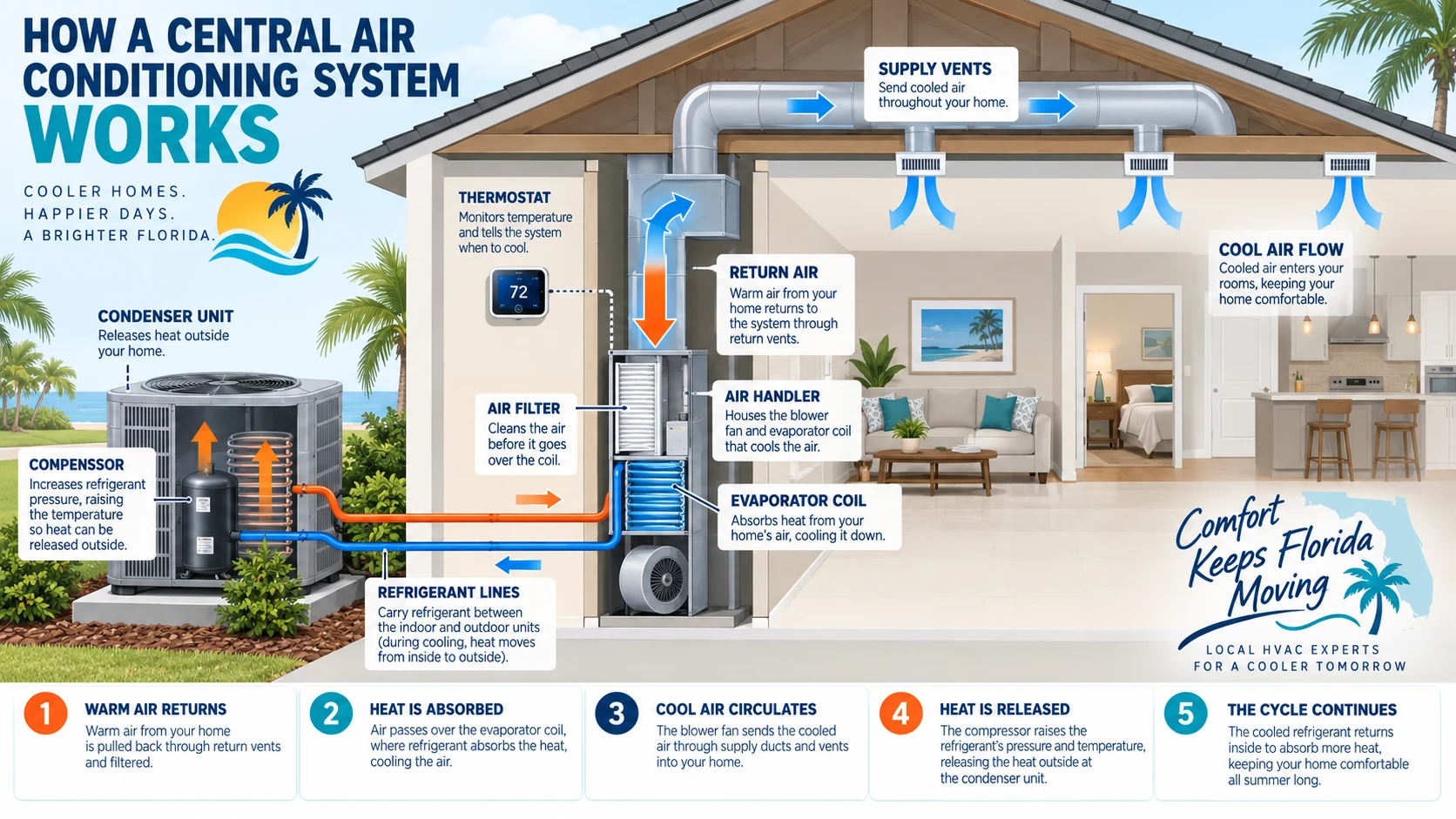
An air conditioner does not create cold air. It moves heat out of your house and releases it outdoors, then sends the cooled, drier air back through the ducts. Nine parts do the work, and almost every cooling complaint traces back to one of them.
The thermostat starts the process. When the room temperature rises above the setpoint, it closes a circuit that tells the indoor blower and the outdoor unit to run. If that signal never arrives, nothing else in the chain matters.
Return air is the warm household air pulled back into the system through return grilles. Return sizing and sealing matter more than most homeowners expect: an undersized or leaky return starves the whole system and can pull hot attic air into the airstream, which is a duct problem, not an equipment problem.
The filter sits where that return air enters the equipment. Its first job is protecting the coil and blower from dust. A loaded filter chokes airflow, and reduced airflow is the leading cause of frozen coils and weak cooling.
Inside the air handler, air passes over the evaporator coil. Cold refrigerant inside the coil absorbs heat from the air, and because the coil surface is below the dew point, water vapor condenses on it and drips into the drain pan. That is where a home's humidity control actually happens.
The blower is the fan that pushes air across that coil and out into the ducts. Blower speed and duct condition determine how much air actually reaches each room, so a strong compressor paired with a weak blower still gives you a house that will not cool.
Refrigerant is the transfer fluid. It absorbs heat indoors by boiling into a gas at low pressure and gives that heat up outdoors when it condenses back to a liquid. It is not consumed. If a system is low, there is a leak, which is why “just add refrigerant” is a temporary answer to a cooling loss.
The compressor in the outdoor unit raises refrigerant pressure and temperature so the heat it carries can be dumped into outdoor air. It is the most expensive single component in the system, and protecting it is the reason airflow and refrigerant problems should not be left running.
The condenser coil and outdoor fan release that heat. Dirt, crushed fins, or a failed fan motor all trap heat in the system and show up indoors as warm vents. Finally, the supply ducts carry cooled air back into the rooms. Leaks, kinks and poor insulation there waste capacity you already paid to produce.
A longer walkthrough of the cycle, including how humidity removal works, is on the how central air conditioning works page.
Common Reasons an AC Stops Cooling
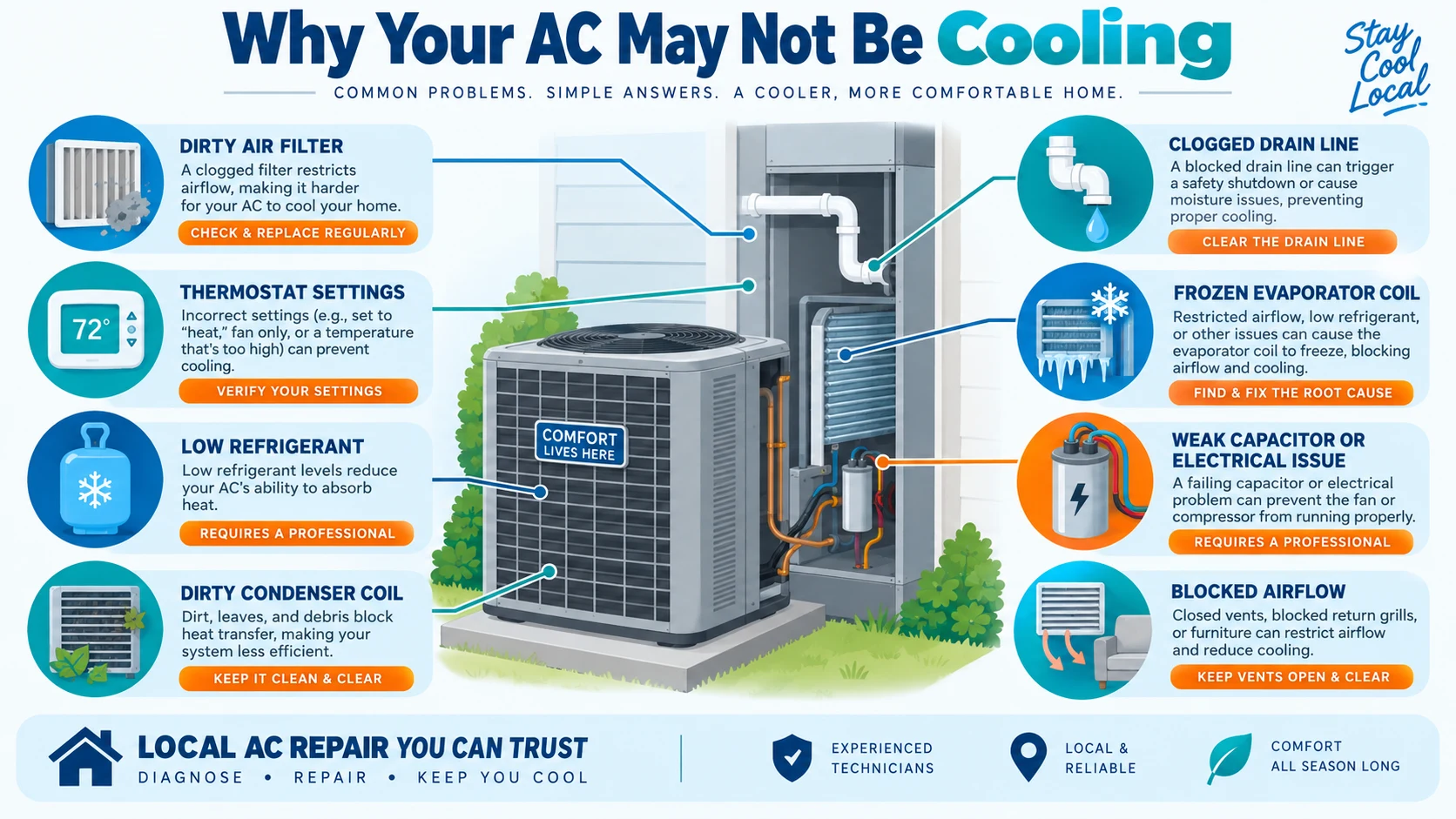
Group the causes and the diagnosis gets simpler. Nearly every no-cool call falls into one of three families: airflow, refrigerant, or electrical.
Airflow problems include a loaded filter, closed or blocked supply vents, furniture over a return, a dirty evaporator coil, a weak blower, and collapsed or disconnected duct. Symptoms overlap: weak air at the registers, ice on the coil, longer run times, and uneven room temperatures.
Refrigerant problems almost always mean a leak. Low charge lowers coil temperature and capacity, so you get a system that runs constantly, may freeze, and cools worse on the hottest afternoons. Finding the leak matters more than recharging the system.
Electrical problems cover capacitors, contactors, relays, fan motors, control boards and the thermostat circuit. A weak capacitor is one of the most common single failures in this climate, and it often presents as a humming outdoor unit whose fan is not spinning while the indoor blower runs normally.
A fourth group is worth naming: safety shutdowns. Float switches and high-pressure switches stop the system on purpose when a drain backs up or pressures climb. Nothing is broken in the usual sense, but the system will not cool until the underlying cause is cleared.
The full symptom-by-symptom walkthrough, including a homeowner-safe checklist, is on the AC not cooling page.
Repair or Replace? What to Weigh
There is no age at which every system should be replaced. Condition, repair cost and actual performance carry more weight than the year stamped on the data plate.
| Factor | Leans toward repair | Leans toward replacement |
|---|---|---|
| System age | Still within typical service life | Well past typical service life |
| Repair frequency | First real failure | Third or fourth call in two seasons |
| Comfort | Cools evenly when working | Rooms never match the thermostat |
| Humidity | House feels dry at setpoint | Clammy air even when temperature is met |
| Energy use | Bills consistent with past summers | Steadily climbing with no other change |
| Major component failure | Non-sealed-system part such as a motor or capacitor | Compressor or coil in the refrigerant circuit |
| Repair cost vs. replacement | A small fraction of replacement cost | A large share of replacement cost |
More detail on that decision is on the AC replacement page, and installation factors that affect how a new system performs are covered under AC installation.
What Homeowners Want From an AC Service Call
These are the service expectations this site is built around.
Clear communication
Plain answers about what is happening with the system and what the next step is, without jargon.
Problem-focused diagnostics
Time spent identifying the actual fault instead of replacing parts and hoping the symptom disappears.
Repair options explained
What can be repaired now, what may be worth watching, and where replacement enters the conversation.
Respect for the home
Careful work around flooring, closets, attics and garages, and cleanup when the work is finished.
Straightforward next steps
A clear description of parts, follow-up needs, or checks a homeowner can handle without a visit.
Cooling performance checked
Confirmation that the system is actually cooling and draining properly before the visit ends.
Palm Bay and Nearby Service Areas
Palm Bay covers a lot of ground, and the homes in it range from newer builds to houses on their second or third system. These pages cover the cooling problems that come up most often in each area.
- AC Repair in Bayside Lakes
AC repair help for Bayside Lakes homes in southern Palm Bay.
- AC Repair in Port Malabar
Cooling repair information for the Port Malabar area of Palm Bay.
- AC Repair in Lockmar Estates
AC, air handler and ductwork repair questions for Lockmar Estates.
- AC Repair in Malabar
AC repair help for Malabar, a small town east of Palm Bay.
- AC Repair in Grant-Valkaria
Cooling repair help for Grant-Valkaria, south/southeast of the Palm Bay area.
- AC Repair in West Melbourne
AC repair information for West Melbourne homes in Brevard County.
- AC Repair in Melbourne
Cooling repair help for coastal and inland Melbourne homes.
What AC Repairs Generally Cost
Repair pricing tracks three things: the part that failed, how long it takes to reach and replace it, and whether the refrigerant circuit is involved. A thermostat or capacitor is a short visit with an inexpensive part. A leak search, coil replacement or compressor repair means more labor, more material and a bigger conversation about the system's future.
The cost guide breaks the common categories into general planning ranges and explains what drives each one. Those figures are educational planning ranges, not a quote.
Palm Bay AC Repair Questions
How much does AC repair cost in Palm Bay?
It depends on the failed part and how long the diagnosis takes. Simple work such as a capacitor, a contactor, a clogged condensate drain, or a thermostat replacement usually lands at the lower end. Repairs involving a blower motor, condenser fan motor, refrigerant leak search, or coil work sit higher because parts cost more and the labor takes longer. Compressor failure and refrigerant-circuit repairs are the most expensive, which is when replacement often gets compared side by side. Our AC repair cost guide breaks the categories down with general planning ranges, and the estimator gives you a range based on the symptom you are seeing.
Why is my AC running but not cooling?
The most common causes are restricted airflow, a dirty outdoor coil, a frozen evaporator coil, low refrigerant from a leak, or an outdoor unit that is not running while the indoor blower keeps going. Start by checking the filter, confirming the thermostat is set to cool with a temperature below the room reading, and looking at whether the outdoor fan is spinning. If the filter is clean, the thermostat is set correctly, and the outdoor unit is silent or the coil is iced over, the problem is inside the sealed refrigerant circuit or the electrical components and needs measurement tools to pin down.
What should I check before calling for AC repair?
Check the air filter, the thermostat mode and setting, the breaker for both the air handler and the outdoor unit, and the emergency shutoff switch near the indoor unit. Look for a full condensate pan or a tripped float switch, which cuts the system off on purpose to prevent water damage. Note what you hear and when the problem started. Those details often shorten the diagnosis and occasionally solve it outright.
Why does an AC coil freeze?
Ice forms when the coil gets colder than it should, and that happens for two broad reasons: not enough warm air moving across the coil, or not enough refrigerant in the system. Dirty filters, closed or blocked vents, a failing blower, and collapsed duct all reduce airflow. A refrigerant leak lowers pressure and drops the coil temperature below freezing. Running the system with a frozen coil can damage the compressor, so turn cooling off, leave the fan on to thaw the ice, and get the underlying cause diagnosed.
What causes an air conditioner to leak water?
Cooling pulls moisture out of the air, and that water has to drain. A clogged condensate line, a rusted or cracked drain pan, a disconnected drain fitting, or a slab-level air handler with no slope will all put water on the floor. A frozen coil that thaws can overwhelm the pan as well. Many systems have a float switch that shuts cooling down when water backs up, so a system that stops cooling and a small puddle nearby often share one cause.
Can a thermostat cause an AC to stop cooling?
Yes. A thermostat with dead batteries, a loose wire, or a failed relay can stop the call for cooling entirely, and one installed in direct sunlight or near a supply vent can read the wrong temperature and cycle the system oddly. Fan-only mode is another frequent culprit: the air moves but nothing is being cooled. Before replacing anything, it helps to verify whether the thermostat is sending a signal at all.
Should I repair or replace my AC?
Age alone is not the answer. Compare the cost of the repair against the value of the equipment, how often it has needed service, whether it still holds humidity down, and whether the refrigerant and parts are still readily available. A single repair on a well-maintained system usually makes sense. Repeated failures, a major refrigerant-circuit repair, or a system that no longer keeps the house comfortable are the cases where replacement deserves a serious look.
What areas around Palm Bay are served?
Palm Bay neighborhoods including Bayside Lakes, Port Malabar and Lockmar Estates, plus nearby Brevard County communities such as Malabar, Grant-Valkaria, West Melbourne and Melbourne. The service areas page lists each one with details about the AC problems common in those homes.
Talk Through Your AC Problem
Describe what the system is doing and we can sort out what likely needs attention and what service options are available. For urgent cooling problems, call to check current availability.
321-334-2567Air Conditioning Repair Palm Bay FL
3425 Bayside Lakes Blvd SE, PMB 1056Palm Bay, FL 32909
Mailing and business contact address.
Prefer to send details?
The service request form collects your contact information, ZIP code, the service you need and a description of the problem, so the conversation starts with the useful details already in hand.
Open the service request form